



The compound interest effect – every savvy investor knows the term. But many are unaware that companies can leverage this effect when using AI in their marketing and sales processes. This is definitely a reason to take a closer look at this great mechanism.
So what is the compound interest effect?
If I can earn a 5% return on a yearly basis, I can withdraw the money and spend it. Or I can leave it in the bank as additional investment. Then, after one year, I will have $105 instead of $100 in my account. This will also generate a 5% return. So the following year, I will receive not only 5 euros, but 5.25 euros – a 5.25% return on my original investment instead of the nominal 5%. And so on.
What does this have to do with AI?
Consider that AI consists of two terms: “Artificial” and “Intelligence.”
At the end of the day, “artificial” can simply be translated as “automated.” We automate something to make it faster and/or cheaper. “Cheaper” can also be expressed as “faster”. Because if something requires less effort and costs less, we can afford to buy it more frequently, with shorter time spans in between.
And there we have one half of the equation—the compound interest effect of AI: We can use the personnel and time savings that AI automation brings to spend less money or put in less effort. Or we can invest the same amount of money and time to achieve much more.
If we were once able to optimize a process in the company on a quarterly basis, we can now optimize it on a daily basis or even once an hour—without putting in more effort. Each time, there is more “credit” in our optimization “account,” so that each further optimization starts from a higher level and yields more than the nominal “interest.”
And where does the “Intelligence” come in?
This brings us to the second part of “Artificial Intelligence.” The beauty of Machine Learning - in other words AI - lies in the “Learning.” Just as a reasonably intelligent person learns from each new experience and doesn't run into the same tree twice, AI models learn with every new data point.
With AI automation, I can optimize more frequently and my “credit balance” will grow more rapidly. Furthermore, the models learn with each additional optimization loop. So, they will get better at recognizing and operating the decisive levers. In other words, my “interest rate” will also increase. Like a 5% nominal interest rate hiked up to 5.5%.
So, after one cycle, we will have achieved 5% of the original 100 euros, then 5.5% of the resulting 105 euros, and so on—the curve will become ever steeper.
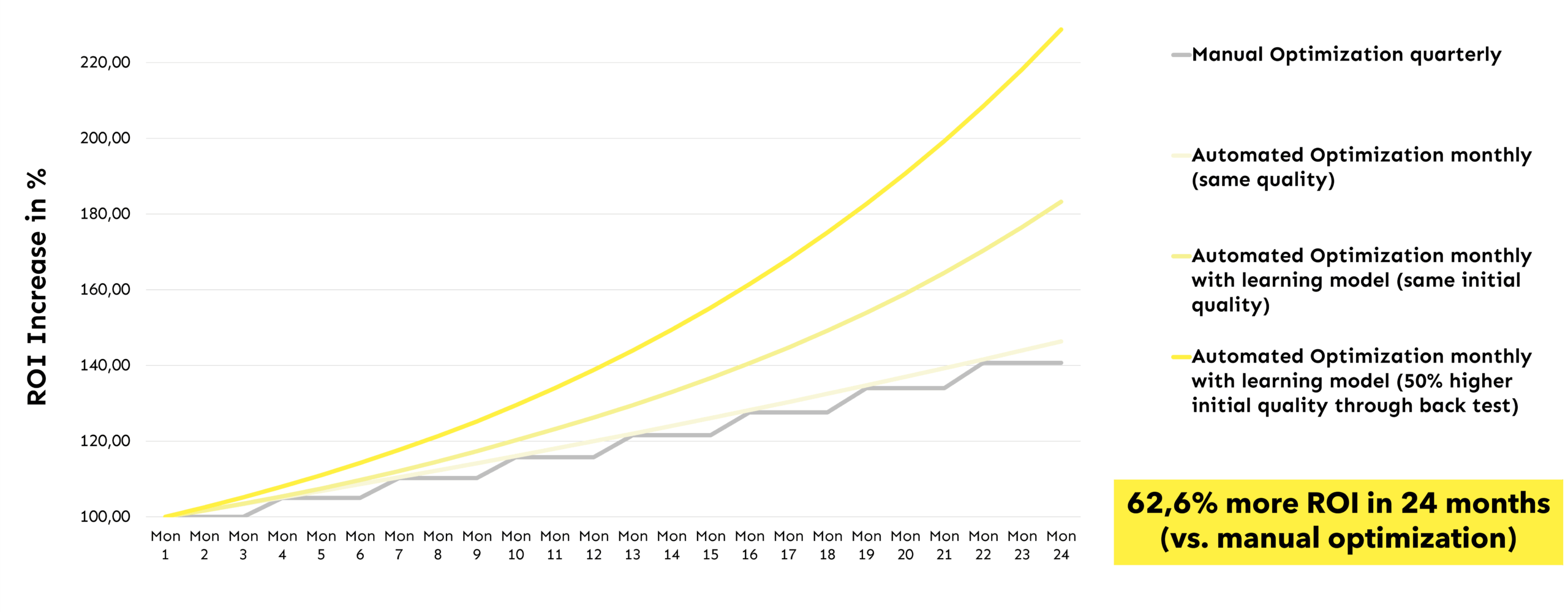
It all sounds great, but it is abstract – what does that really look like in practice for your business?
Let's take two simple examples from the core discipline of NEUTRUM.AI: Marketing and Sales.
Case 1: Marketing – More return on the advertising budget
A company aims to optimize its advertising campaigns. To do so, it reviews them once a quarter to see how they performed and what can be improved in order to adjust the relevant parameters. Each time, it achieves 5% more budget efficiency by adjusting the advertising content, the targeting and the media mix.
Let us say the company uses NEUTRUM EVO Optimizerenabling it to achieve continuous improvement - now let's be conservative and say the company will review the AI models' learnings once a month to implement the most up-to-date recommendations. The higher frequency alone will already yield 3.6% more ROI within a year.
However, on top of this, AI models can compute better and more impartially than humans and they are learning constantly. Typicalls, this makes them between 2.5 and 20 times better than humans using normal statistics. But let's modestly assume that they start out 50% better and that they only improve by 0.1% each month. This leverage adds an additional 19.6% more ROI to the account within a year. And even if the model had not been better than manual analysis at the start (an utterly strange assumption), we would still have fared 9.4% better than with conventional methods.
And the learning does not stop there - well to the contrary, the learning curve steepens: after 2 years, monthly AI-supported optimization achieves 62.6% (!) more ROI than quarterly manual optimization. We're talking about 2.67 times as much revenue with the same advertising budget!*
Case 2: Sales – More deals closed with the same level of staffing
In B2B sales, a company gains outbound leads by looking for companies that are likely to need its products. The company will research the necessary information for the right approach, and then contact the best prospects via LinkedIn, email or telephone.
Now let’s see what happens once the same company begins to use NEUTRUM B2B Client Finder Finder to automate lead generation. The AI algorithms tap into all relevant sources, evaluate the information and present profiles that are ready for immediate use. This equates to a 95% time saving. In other words, if a sales representative previously spent 4 hours a day researching and qualifying leads, they now only need 12 minutes. In an 8-hour day, they have 95% more time to contact target clients and negotiate with them. So, they should be able to close almost twice as many deals.
Even better, if the same company connects its CRM system to NEUTRUM, the AI models learn from the characteristics of the best clients, empowering them to make predictions about the best potential customers with a much higher degree of confidence. So, the sales department will be able to focus entirely on the predicted A-clients. As a very conservative assumption, the sales department should be able to double its conversion rate.
Thus, the company is generating 3,8-times as much new deals with the same team - in no time at all!**
So have you finally found the “Perpetuum Mobile”?
Not really… AI cannot work magic or defeat physics. What you have here is the amazing outcome of simple mechanisms at work: I can save a lot of time and money through automation. I can maximize added value (e.g., better advertising efficiency, more sales calls). Machine Learning enables me to learn faster, so that I can be more accurate and take more effective measures.
The ones who reinvest their earned interest and returns, the ones who continuously learn from their successes and failures in order to adapt their strategy, end up with significantly more profitable operations.
When do you want to take the first step to benefit from the AI-compound-interest-effect for your business?
Arrange your free and non-binding info call now!
* In the case of optimisation not just for effectiveness, but for cost efficiency - here: a 62.6% greater reduction in the cost per order. If you only optimised for effectiveness with unchanged cost efficiency - i.e. a higher order rate - you would "only" achieve 62.6% more turnover. This shows how important it is to take a differentiated view of results - efficiency - quality, as our NEUTRUM EVO Optimizer automatically... and that, as a rule, optimising efficiency provides the strongest leverage.
** 95% more time for customer contact, with twice the deal rate = 2*1.95 = 3.8




 German